
Running a session
Better controls produce better questions.
Meridian Loom can be opened and used immediately, but a consistent process makes sessions easier to interpret — and easier to compare against past sessions or another investigator's results.
Before you begin
Reduce obvious interference. The magnetometer reads the field relative to the phone, so anything nearby with its own magnetic signature will show up in the reading. Move away from speakers, chargers, motors, magnetic phone mounts or cases, and other electronics where practical.
Establish a baseline. Give the environment and the device a moment to settle before you start asking questions. A brief quiet period at the start of a session gives you something to compare later activity against.
Keep the phone consistent. Place or hold the phone in a stable position and try to maintain it. Because the magnetometer reads relative to the phone itself, repeatedly rotating or repositioning the device will change the reading on its own — not because the field around you changed, but because the phone's orientation did. See "How It Works" for why that happens.
Dialing in sensitivity and motion damping
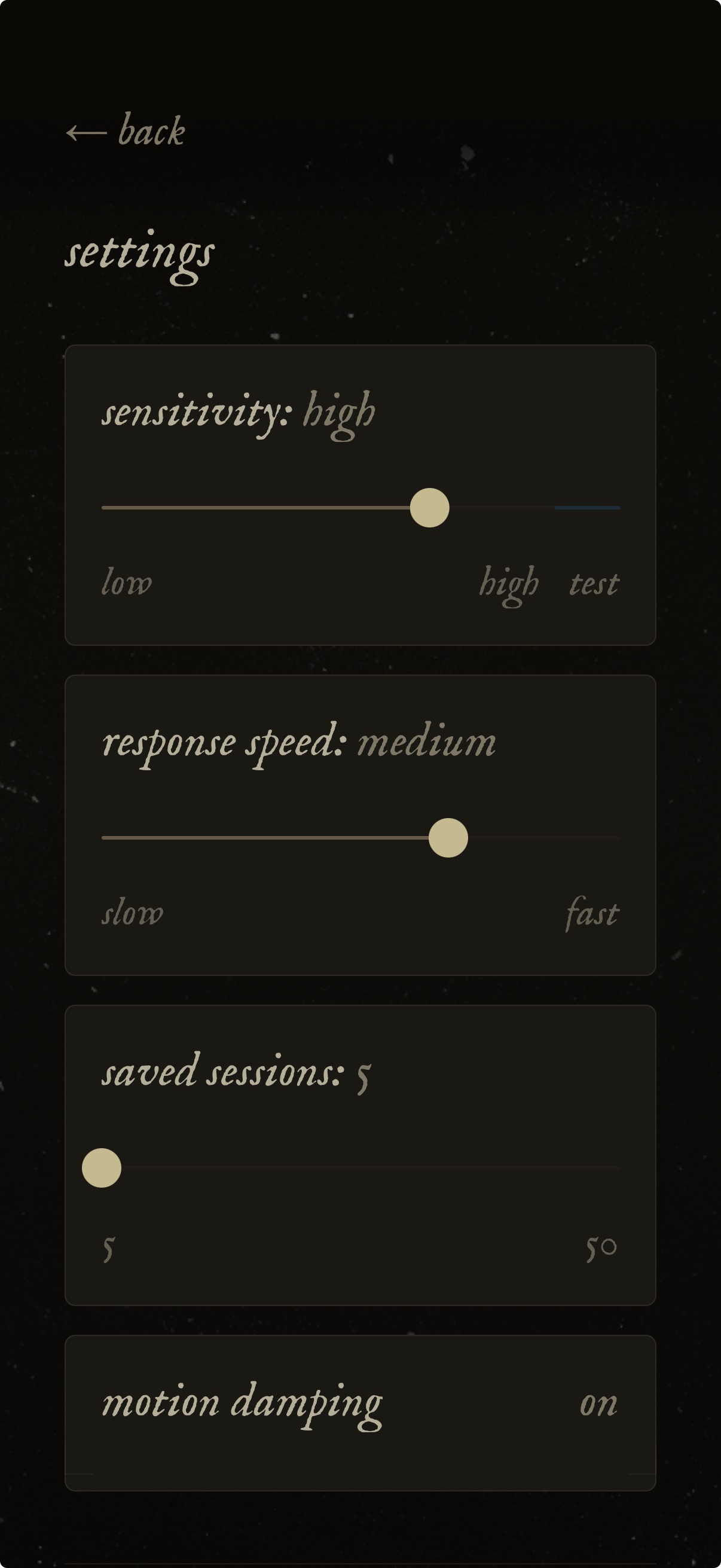
Every environment carries a different amount of ambient magnetic noise, and every investigator holds a phone a little differently. Sensitivity and motion damping let you tune Meridian Loom to the conditions in front of you.
Sensitivity sets how much field movement is needed before a word surfaces. In a location with a lot of ambient magnetic noise, a lower sensitivity setting keeps small, incidental fluctuations from triggering output. In a quieter location, raising sensitivity lets smaller, more deliberate movements register. Sensitivity never changes which word belongs to a given position — only how easily that position is reached.
Motion damping is for sessions where you're moving through a space — walking a hallway, sweeping a room — rather than holding the phone still in one spot. Ordinary hand tremor while standing still is generally handled by sensitivity alone. Damping matters when the phone's position itself is changing throughout the session, so that movement from point A to point B doesn't register the same way as movement in the field.
There's no universal correct setting for either control. Start conservative, note what you used, and adjust between sessions rather than mid-session, so a single session stays internally consistent.
During the session
Ask clearly. Use direct questions and leave space between them. Rapidly rephrasing the same question to try to provoke a response makes it harder to tell later which output corresponded to which question.
Record the context. Note anything relevant as it happens — environmental changes, sounds, movement in the space, readings from other equipment you're running alongside Meridian Loom. This context is what makes a transcript useful later, not just the words themselves.
Let silence sit. A quiet stretch is a normal outcome, not a sign something is wrong. See "How It Works" for why the app doesn't fill silence with output.


After the session
Review the full transcript, not just individual words in isolation. A word's position in the sequence, and what was happening around it, matters more than any single entry on its own.
Repeat and compare. A single session is a data point. Returning to the same location under similar conditions, and comparing transcripts, is more useful than treating any one session as conclusive.